

Autonomous Commerce: What commercetools Announced and How to Prepare

Enterprise commerce is entering a new phase of AI adoption. Rather than simply assisting employees or enhancing customer experiences, AI is beginning to take responsibility for operational decisions that have traditionally required human oversight. Done well, that means optimizing more of the business automatically, increasing revenue, improving margins, and lowering operating costs at the same time.
commercetools' Autonomous Commerce announcement at Shoptalk Europe on June 9, 2026 reflects that direction. Alongside the introduction of its renamed Sphere platform and the preview of the MosAIc orchestration layer, the company outlined a vision in which AI agents coordinate commerce operations within business-defined guardrails.
The capability isn't fully ready today, and that's precisely why this matters now. Organizations that begin preparing their data, governance, and operational foundations will be positioned to move first as the technology matures. This article explains what commercetools announced, explores practical examples of how autonomous commerce could work in the real world, and outlines the steps you can take today to prepare.
What Autonomous Commerce Means
At its core, autonomous commerce means AI systems that can observe what's happening, decide on an appropriate action, and carry it out within business-defined boundaries.
Unlike traditional rules-based automation, which depends on predefined workflows and exceptions for every scenario, autonomous systems operate toward business objectives within defined constraints, adapting their decisions as conditions change.
Autonomous commerce also differs from agentic commerce, which typically focuses on customer-facing experiences such as shopping assistants that research products or make purchases on a customer's behalf. Autonomous commerce instead applies AI to internal operations rather than customer-facing ones.
What commercetools Announced
The announcement centers on two platform components: Sphere and MosAIc.
Sphere rebrands commercetools' existing API-first commerce platform while introducing the governance model needed for AI agents. Rather than granting broad system access, agents receive defined identities, permissions, and operational boundaries, a prerequisite for autonomous decision-making in enterprise environments. According to commercetools, the platform already processes more than $100 billion in annualized GMV with average response times below 60 milliseconds. That scale matters because autonomous agents will generate substantially more API traffic than traditional user-driven commerce.
MosAIc was previewed as a multi-agent orchestration layer, coordinating AI across pricing, promotions, fulfillment, and other operational domains.
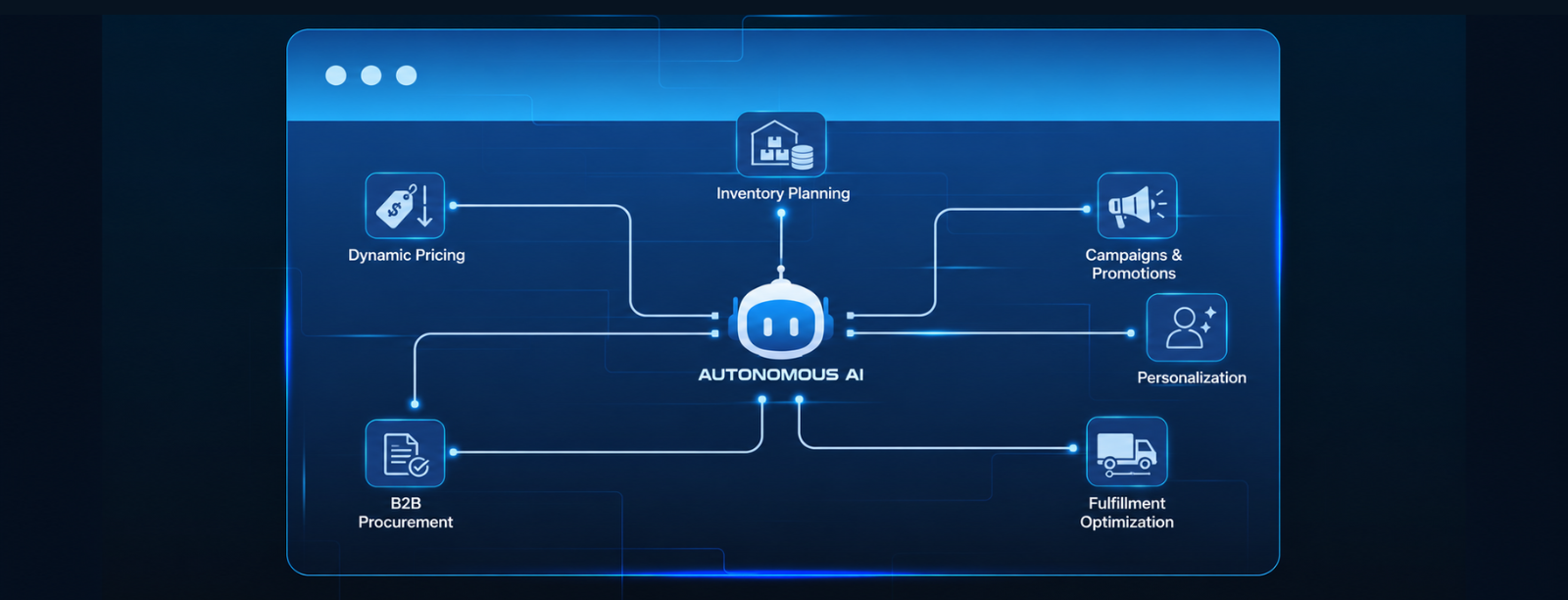
Six initial use cases were outlined: dynamic pricing, inventory planning and replenishment, campaigns and promotions, personalization, fulfillment optimization, and B2B procurement.
The company also identified three prerequisites: a headless, API-first foundation that exposes products, pricing, inventory, and checkout in real time; an intelligence layer capable of orchestrating multiple AI agents; and governance with human oversight where appropriate. While all three are necessary, governance will likely determine whether autonomous commerce succeeds in practice.
What's Available Today vs. What's Still Roadmap
The API-first foundation isn't new, and it's a large part of why commercetools is well positioned here. AI agents are most effective when every capability, from catalog management to checkout, is already exposed through APIs. The GMV and latency figures above describe production traffic today.
The orchestration and governance capabilities are still emerging. MosAIc was introduced as a preview, and the announcement's own language describes what Sphere "will enable" rather than what it does now. Treat the autonomous workflows as a roadmap rather than features you can switch on today.
Industry analysts predict a similar timeline. commercetools cites Gartner placing AI agents for commerce operations at transformational impact within two to five years, with early use cases in merchandising configuration and campaign setup, and productivity as the primary benefit. Productivity improvements are a more realistic near-term promise than autonomy.
Why Governance Is the Limiting Factor
Many conversations about autonomous commerce focus on how intelligent the AI is. If you've used AI for complex tasks like coding, you know it's already highly capable and improving. For most enterprises, the limiting factor is unlikely to be AI capability. It will be governance.
Consider dynamic pricing. An autonomous agent monitoring competitor prices, inventory levels, demand, and margin targets, adjusting in real time, is technically impressive. Operationally, it raises harder questions. How much can a price move in an hour? What's the minimum acceptable margin? Which products should never be discounted automatically? What happens when a competitor's pricing feed is wrong? When should the system stop and ask for approval?
None of those are capability questions. They're governance questions. And they matter because AI rarely creates entirely new operational problems, it amplifies existing ones at speed and scale.
Six Use Cases With Readiness Considerations
All six use cases identified by commercetools are technically achievable, but none should be viewed as a feature that can simply be switched on. Each carries its own data prerequisites and policy decisions.
1. Dynamic pricing
Organizations need reliable competitor pricing feeds, refreshed frequently enough to reflect current conditions. Pricing strategies should include product-specific floors and ceilings, MAP and MSRP compliance where applicable, and velocity limits that prevent excessive movement over short periods. Starting with lower-risk categories lets teams validate performance before expanding to more strategic products.
Governance is equally important. Circuit breakers should halt automated pricing if aggregate margins fall below defined thresholds, and audit logs should make it easy to explain why a particular price was set weeks or months later. In B2B, contracted pricing, customer-specific agreements, and volume discounts must also be incorporated, as pricing consistency carries greater customer expectations than in B2C.
2. Inventory planning and replenishment
Inventory counts must closely match physical stock, with updates frequent enough to prevent unnecessary replenishment or stockouts. Supplier lead times, minimum order quantities, and purchasing constraints should reflect actual supplier capabilities rather than ideal assumptions. Purchasing history, seasonality, promotions, and demand patterns all need to inform replenishment, while new products require comparable historical baselines. Budget limits and approval thresholds help prevent overreaction to temporary demand spikes or anomalous data.
3. Campaigns and promotions
Organizations need a unified customer profile rather than fragments spread across commerce platforms, marketing automation tools, and analytics systems. Creative assets should exist for every audience and channel combination the AI may select, otherwise available content becomes the limiting factor rather than the intelligence behind it.
Governance should define discount limits, stacking rules, and minimum margin thresholds to prevent unintended combinations of automated offers. Attribution deserves attention too. Because campaign performance often takes days to stabilize, agents optimizing within hours risk deciding on incomplete information.
4. Personalization
Personalization builds on many of the same foundations as campaign optimization, but under much tighter performance requirements.
Customer identity must be resolved in real time, connecting anonymous and known visitors across devices while staying within page-load latency budgets. Real-time behavioral signals, structured content, and sufficient creative variation are all required for personalization to mean anything.
Business priorities should also shape recommendations. Without explicit merchandising guardrails, optimization focused solely on conversion could unintentionally suppress new products or strategically important categories. Consent management must be enforced before personalization occurs, with market-specific privacy requirements respected throughout. And because customer signals will always be incomplete, fallback experiences remain as important as personalized ones.
5. Fulfillment routing
Fulfillment routing is arguably the most mature use case because its objectives are well defined and outcomes are immediately measurable.
Success depends on accurate inventory visibility across fulfillment locations and reliable carrier performance data. Just as importantly, organizations must define what "optimal" means. Minimizing shipping cost, maximizing delivery speed, and meeting promised delivery dates may each produce different routing decisions. Business rules should also account for customer tiers, order types, and service-level commitments.
6. B2B procurement
Contract terms, compliance requirements, and purchasing policies often exist only in documents or institutional knowledge. Converting those into machine-readable policies is a prerequisite for meaningful autonomy. Approved supplier lists, approval thresholds, escalation paths, and budget authorities must all be explicitly defined and maintained.
Procurement agents also require integration with the systems where purchasing actually occurs, typically ERP or procure-to-pay platforms. Without the ability to execute approved transactions, an autonomous procurement agent remains another recommendation engine.
Combining Use Cases Through Orchestration
It's easy to think about these use cases independently, but in reality each may impact another.
Imagine a pricing agent raising prices because inventory is running low. At the same time, a marketing agent launches a promotion to drive demand for that same product, while a personalization engine features it more prominently because engagement is climbing. Individually, every decision could make sense given the data it was provided. Combined, they work against each other.
That's why orchestration is the long-term objective: a coordinated system where decisions in one area account for what's happening everywhere else. This appears to be the role MosAIc is intended to play, coordinating first- and third-party agents around shared business goals rather than adding another isolated AI capability.
The practical implication is that conflict resolution depends on an established ruleset. When margin protection and revenue targets disagree, the tie-breaker should be a rule you wrote deliberately, not whichever agent happened to act first.
Preparing for Autonomous Commerce
The good news is that most of this preparation doesn't depend on waiting for new platform capabilities.
Start with the operational decisions your teams make every day. Which are repetitive? Which follow well-understood rules? Which are measurable and relatively low risk? Those are your best candidates for early autonomy.
Then invest in the less glamorous work. Improve data quality in the domains you'd eventually automate. Document the pricing policies, approval thresholds, escalation paths, and promotional rules that currently live in spreadsheets or in experienced employees' heads, because those become your guardrails. Make sure product and content data is structured so systems, not just people, can interpret it.
Plan for the human side too. A merchandiser who spent their week adjusting prices and building campaigns moves toward setting objectives, establishing guardrails, and reviewing exceptions. That's a more strategic role, and also a different one, and teams that prepare for the shift will adapt more smoothly than those caught by surprise.
Most importantly, don't try to automate everything at once. Organizations that succeed will follow a progression, with recommendations first, then human-reviewed execution, then limited autonomy within defined boundaries, and finally broader coordination across functions. Every stage earns the confidence for the next.
Autonomous commerce isn't primarily a technology challenge. For most organizations, it's an operational readiness challenge. AI can only operate as autonomously as the quality of the data, governance, content, and business processes surrounding it allow.
The preparation required for autonomous commerce aligns closely with the work TransPerfect already helps organizations do every day. We help clients strengthen the foundations autonomous commerce depends on, including high quality data, structured content, clear governance, automated operational workflows, and modern commerce platforms. Those investments deliver value today while positioning organizations to adopt autonomous commerce faster, with greater confidence, as the technology matures. Whether you're assessing your current readiness or building a long-term roadmap, we can help you prepare to move first.